As a supplier specializing in pet food production lines, I’ve spent over a decade on the factory floor, working closely with pet food manufacturers who’ve faced the same frustrating challenge: one batch of kibble too crumbly, another too dense, treats that crumble mid-packaging, and dog food that’s inconsistent enough to turn off even the pickiest four-legged customers. Uniform texture isn’t just a quality box to check—it’s what builds trust with pet owners, meets regulatory standards, and cuts down on costly product rejections. Over the years, I’ve seen what works (and what doesn’t) when it comes to keeping texture consistent across every meter of a production line. Let’s break down the science and strategies that make it happen, straight from someone who’s installed, troubleshooted, and upgraded these lines hundreds of times. Pet Food Production Line
First, let’s get one thing clear: texture inconsistency almost never stems from a single mistake. It’s the small, unaddressed gaps in pre-production prep, process control, and equipment maintenance that add up. I once worked with a mid-sized pet food maker who was throwing out 12% of their chicken-flavored kibble batches for uneven texture—turns out, their grain storage bins were allowing moisture to settle unevenly, and their extruder screws were worn down just enough to mess with dough consistency. That’s the kind of hidden flaw that slips through if you’re not intentional about every step.
The foundation of uniform texture starts long before raw materials enter the production line: it’s raw material sourcing and preparation. You can’t make consistent pet food if your core ingredients aren’t consistent themselves. Protein sources like chicken meal, grain blends, or fiber additions (like pumpkin or beet pulp) naturally vary in moisture, particle size, and composition from supplier to supplier, or even batch to batch from the same supplier. For example, a 5% difference in moisture in ground chicken meal might not matter for a single pot of homemade pet food, but on a production line that runs 1,000 kg per hour, that tiny shift will throw off the extrusion process entirely.
My advice here is two-fold. First, build raw material specs that are non-negotiable. We work with suppliers who specify that all incoming protein meals must have a 10-12% moisture range, particle size of 90% passing through a 2mm sieve, and fat content within ±0.5% of the target. No exceptions. Second, invest in a pre-conditioner with precise moisture and temperature controls—this is a piece of equipment most small-scale producers undervalue. The pre-conditioner’s job is to blend dry ingredients with steam and water to create a uniform dough before it hits the extruder. If the pre-conditioner’s steam injection is inconsistent (even a few missing nozzles), you’ll end up with dry clumps and soupy spots in your mix before extrusion even starts. Last year, we retrofitted a pre-conditioner for a client who’d been struggling with 8% texture-related rejections; adding two new steam manifolds and calibrating water flow cut that rework rate to 1.2% in three months.
Next, the heart of the line for texture: extrusion. This is where the magic happens (and where most texture issues are born). Extrusion works by forcing the pre-mixed dough through a die plate at high pressure and temperature, shaping it into kibble or treats. The key here is two things: consistent dough feed to the extruder, and precise control of the extrusion process parameters (temperature, pressure, screw speed).
Let’s start with feed. A lot of older lines rely on gravity-fed hoppers to deliver dough to the extruder, which means the flow can spike or slow down depending on how full the hopper is, leading to inconsistent dough consistency. The fix? Add a loss-in-weight feeder for the extruder. This device uses continuous weight measurements to adjust the rate of dough input, keeping the extruder’s feed rate within ±1% of the target—no more spikes in crumbly kibble when the hopper is full, or dense, hard pieces when it’s low. I’ve seen loss-in-weight feeders transform lines where texture was a chronic problem; one client told me they went from 15% product rejections to less than 2% after installing two feeders on their twin-screw extruder.
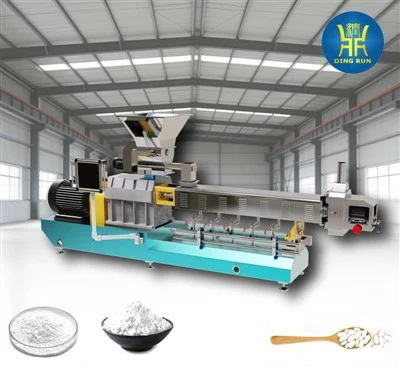
Then there’s the extruder itself. Twin-screw extruders are now the standard for high-quality pet food for a reason: they offer far more consistent mixing and pressure control than single-screw models. Single-screw extruders tend to have uneven shear along the screw length, which can cause some parts of the dough to overcook and others to undercook, leading to texture gaps. But even twin-screw lines need regular maintenance to stay uniform. Worn screw segments are a big culprit: if the screw’s flighting (the raised parts that move dough forward) is chipped or worn down after 18-24 months of heavy use, the shear and pressure inside the extruder will vary along the length of the barrel, creating inconsistent kibble density. We recommend that clients schedule quarterly checks of extruder screws, replacing segments when wear reaches 10% of the original thickness. Also, don’t overlook the die plate—small holes in the die can clog with dried dough over time, or become misaligned, leading to uneven kibble sizing and texture. A die plate cleaning routine (daily, for high-volume lines) and replacing die plates every 12 months will keep your extrusion output consistent.
Once the kibble is extruded, it goes through drying and cooling—two more steps where texture can get thrown off. This is where a lot of lines cut corners on drying uniformity, especially with older, batch-style dryers. If kibble sits in a dryer in uneven layers, some pieces get too much heat and turn hard, while others get too little and stay soft, leading to spoilage and texture complaints from pet owners. The solution here is a continuous, conveyor-belt dryer with adjustable air flow zones. Modern dryers let you set different temperatures and air speeds across multiple conveyor sections: for example, a high-temperature zone at the start to set the kibble shape, a middle zone for even moisture removal, and a cool-down zone at the end to bring moisture to the target 8-10% range. We also install air distribution baffles in these dryers—these simple panels ensure that air is evenly spread across the entire conveyor belt, not just blowing in one spot. A few years back, I helped a client adjust their dryer baffles; they found that 30% of their texture issues came from uneven air flow, and fixing that cut their texture-related rejections by almost half.
Cooling is just as important as drying, because if kibble cools too fast or unevenly, it can develop cracks or hard edges. I always recommend counter-flow coolers, where cool air is blown opposite to the direction of the kibble’s movement on the conveyor. This lets the kibble cool gradually, keeping texture smooth and consistent, rather than shocking it with cold air. Many older lines use cross-flow coolers, which blow air across the conveyor in the same direction as the kibble, leading to uneven cooling and occasional warping. The switch to counter-flow coolers is a common upgrade we suggest, and it’s paid for itself in reduced product waste for almost every client who makes the change.
Beyond the equipment, there’s a less talked-about part of texture consistency: standard operating procedures (SOPs) and line monitoring. I’ve seen lines with top-of-the-line equipment still struggle with texture because operators are switching between products without recalibrating, or skipping daily checks. For example, if you run a chicken kibble at 140°C extrusion temperature, then switch to a fish treat without adjusting the die pressure, you’ll get inconsistent texture. The fix isn’t just “follow SOPs”—it’s real-time monitoring. We integrate our lines with small, affordable sensors that track moisture in the dough, extrusion pressure, and final kibble moisture at every stage. These sensors send data to a touchscreen on the line, so operators can spot a shift before it leads to a full batch of bad product. One client told me that before installing these sensors, they’d only test final kibble moisture after the entire batch was done; now, they get alerts if moisture drifts by 0.5% mid-batch, and can adjust the pre-conditioner or dryer immediately, cutting down rework by 90% for that line.
I also can’t stress enough the importance of regular line calibration, not just after a breakdown. A lot of operators only calibrate equipment when something breaks, but small shifts over time add up to big texture issues. For example, a feeder that’s off by 2% in dough input might not cause a problem on a small run, but on a 10,000 kg run, that’s 200 kg of inconsistent product. We recommend monthly calibration for all core line components: feeders, extruder temperature sensors, dryer air flow, and conveyor speed. It takes a few hours a month, but it prevents weeks of costly rejections.
Let’s talk about a common misconception: uniform texture doesn’t mean all kibble has to be exactly the same size. Pet owners love variety, but the texture of each piece should be consistent. I once worked with a client who was adding mix-ins (like dried chicken pieces) to their kibble, and they were complaining that the mix-ins were either too hard or too soft compared to the base kibble. The fix here was adjusting the extrusion parameters for the mix-ins, and adding a separate pre-conditioning step for the add-ins to match the moisture and temperature of the base dough before blending. Mix-ins are a great way to appeal to pet owners, but they add another layer of complexity that needs to be accounted for in the line’s process controls.
Another point: waste from previous runs. If you’re cleaning the line between batches, don’t just dump leftover dough or kibble back into the next run—this can introduce inconsistent moisture and texture. We teach clients to collect line waste, grind it into a uniform particle size, and add it back in a controlled, small percentage (usually less than 5%) to the next batch, rather than dumping it in whole. That way, you’re not introducing random lumps or uneven moisture.
At the end of the day, ensuring uniform texture on a pet food production line is a mix of the right equipment, intentional process controls, and consistent maintenance. It’s not a one-time fix—it’s a habit that becomes part of how you run the line. I’ve seen small producers go from 15% texture-related rejections to less than 2%, and large manufacturers cut their rework costs by hundreds of thousands of dollars a year, just by focusing on these steps.
If you’re looking to upgrade your line, troubleshoot consistent texture issues, or build a new production line from the ground up, the right partner can make all the difference. We’ve helped hundreds of pet food makers fine-tune their lines to deliver uniform texture, reduce waste, and build products that pet owners trust. To learn more about how we can tailor a solution for your production needs, connect with our team to discuss your goals, challenges, and equipment requirements. There’s no one-size-fits-all approach, but we’ll work with you to build a line that keeps texture consistent, batch after batch.
Pet Food Production Line References
- Kornegay, J. L. (2010). Extrusion Processing of Pet Foods: Effects on Nutrient Availability and Product Quality. Journal of Animal Science, 88(13), E11-E20.
- Patel, P. D., & Tamadoni, R. (2018). Texture Consistency in Extruded Pet Foods: The Role of Pre-Conditioning Parameters. Food and Bioprocess Technology, 11(7), 1321-1332.
- American Association of Feed Control Officials (AAFCO). (2022). Official Publication: Pet Food Manufacturing Standards. AAFCO, Oxford, IN.
- Zhang, Y., et al. (2021). Continuous Drying and Cooling Systems for Extruded Pet Foods: Impact on Texture and Shelf Life. Journal of Food Engineering, 298, 110457.
Jinan Bright Machinery Co., Ltd
As one of the most professional pet food production line manufacturers and suppliers in China, we’re featured by quality products and good price. Please rest assured to buy advanced pet food production line for sale here from our factory. Contact us for more details.
Address: South Zone, Wande Industrial Park, Changqing District, Jinan City, Shandong Province
E-mail: admin@dingrunmachine.com
WebSite: https://www.chinafeedmachine.com/
